Demo Site
Showing posts with label Artist of the Week. Show all posts

Monday, May 3, 2010

AoTW: Hang on to Your Pelotas, Amigos, it’s Guillermo Gómez-Peña

I'm fortunate to live in a city that has a pretty healthy art community. Could it be better? Well, of course! But it's nothing like the dumpster-fire art scenes that I've experienced in some of the places I've lived. With this in mind, I had a grand idea---I'd highlight artistic going-ons happening around my community and feature a local artist for AoTW. And like the best laid plans of mice and men, it went all to crap because there just aren't many going-ons, well, going on. Or if there are, a scouring of the regional interwebz didn't reveal anything of note. For now, that idea is on the backburner. So, I cast my net a little farther west and south and re-discovered, Guillermo Gómez-Peña.

How does one describe him? Well, urmm, I'm not sure but here is a picture to set the stage.
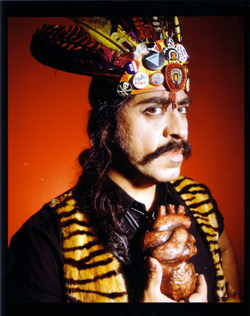
Keep in mind that this is a relatively tame picture of him

Here is a video to further the mood:


Born in Mexico, Gomez-Pena later moved to the United States in 1978 and has since developed a fecundity in a wide array of media producing what is often a cacophony of visual imagery, sound, and outright bizzarro tactics which promote a gestalt of "performance activism and oppositional art."

Some examples of works in this vein:

The Couple in the Cage:

In a series of 1992 performances, Coco Fusco and Guillermo Gómez-Peña decked themselves out in primitive costumes and appeared before the public as "undiscovered AmerIndians" locked in a golden cage—an exercise in faux anthropology based on racist images of natives. Presented eight times in four different countries, these simple performances evoked various responses, the most startling being the huge numbers of people who didn't find the idea of "natives" locked in a cage objectionable. This provocative tape suggests that the "primitive" is nothing more than a construction of the West and uses comic fiction to address historical truths and tragedies. from: http://www.vdb.org/smackn.acgi$tapedetail?COUPLEINTH
Border Brujo:

Sitting at an altar decorated with a kitsch collection of cultural fetish items, and wearing a border patrolman's jacket decorated with buttons, bananas, beads, and shells, Gómez-Peña delivers a sly and bitter indictment of U.S. colonial attitudes toward Mexican culture and history. Whirling through various Mexican American stereotypes, pulling on costumes as easily as accents, Gómez-Peña emphasizes the collision of Mexican and American cultures, their mixture and misunderstanding of each other, each appearing as a dream/nightmare reflection of the "Other." In turns powerful and playful, Border Brujo poignantly illustrates the double edge of forced cultural occupation. from: http://www.vdb.org/smackn.acgi$tapedetail?BORDERBRUJ
Temple of Confessions:

A documentation of a performance/installation. Guillermo Gómez-Peña and Roberto Sifuentes created a fictional religion based on inter-cultural confessions. Exhibiting themselves in Plexiglas boxes as "end-of-the-century saints", the two performers hear the confessions of audience members willing to reveal their intercultural fears and desires to the saints.

"Considered one of the finest performance artists working in the U.S. today, Mexico-born Guillermo Gómez-Peña and his collaborator Roberto Sifuentes have created a surreal, chapel-like environment. In this space, viewers become participants, revealing their innermost fears and feelings about Mexicans, Chicanos, and Mexican cultureÉ People are disturbed, confused, ashamed, hopeful."

--Kathleen Vanesian, Phoenix New Times, February 9th, 1994. from: http://www.vdb.org/smackn.acgi$tapedetail?TEMPLEOFCO

Gomez-Pena's work is certainly confrontational but it is oppositional by design in order to force the average viewer to consider issues that have a tendency to remain in the murky understrata of society. The interface between the viewer, who is often an average museum goer, and the shocking display of overloaded ethnic and cultural symbolism promotes a dialogue that:

...challenges the traditional art world mythologies of the "Artiste" as a suffering bohemian and misunderstood genius. La Pocha artists perform necessary roles in multiple contexts including those of social critics and chroniclers, inter-cultural diplomats and translators/mis-translators, informal ombudsmen, media pirates, information architects, reverse anthropologists, experimental linguists and radical pedagogues. To us the artist is above all, an active, responsible citizen immersed in the great debates of our times. Our place is the world and not the Art World.
For several years now, Gomez-Pena has worked on developing a cross-disciplinary collaboration of like-minded artists who engage in artistic efforts that compel discussion of race, cultural identity, stereotypes, etc. via:

""living museums" that parody various colonial practices of representation including the ethnographic diorama (as found in museums of natural history), the Freak Show, the Indian Trading Post, [etc...] and their contemporary equivalents in global media and corporate entertainment

...the composite identities of our "ethno-cyborg" personae are manufactured with the following formula in mind: one quarter stereotype; one quarter audience projection; one quarter aesthetic artifact and one quarter unpredictable personal/social monster
from: http://www.pochanostra.com/what/
The living museums and other performances promote an idea that works towards:

...an ever-evolving cartography, which inter-connects nomadic, immigrant, hybrid and 'subaltern' rebel artists from various countries bypassing the hegemonic centers of cultural power...

...We seek to articulate another kind of global culture, emerging from within grassroots communities and on the streets, a hybrid culture that often resists, consciously or unconsciously, the 'legitimate' forces of globalization. In this sense, we are part of the 'Other Global Project.' We are particularly interested in the cultures generated by the millions of uprooted peoples, the exiles and migrants from so-called Third World countries, the orphans of crumbling nations and states who are moving North and West in search of the source of their despair. In the process, these 'orphans of the developing world' are creating a new fusion of high/low culture, which, by nature, is anti-colonial, oppositional and experimental. In the process these cultural migrants and political exiles inevitably meet with other migrants, the sexual misfits and aesthetic renegades of the dominant culture. We are interested in the meeting place.

There you have it. When I first found out about Gomez-Pena's work a few years ago, I certainly found it interesting. I couldn't help but be mesmerized in a "how you can't help but look at a car wreck" kind of way. However, considering the administration's ramping up of the immigration debate and the controversial bill just signed into law in Arizona, I think that Gomez-Pena's work rings a different timbre, so to speak. This debate is sure to become more heated in the coming weeks and months and the issues that Gomez-Pena raise, even if you don't agree with the manner in which he does so, are necessary of consideration.
So, if you are fortunate enough to be in an area where he and/or his group is performing, be sure to check them out.


For more info:

Guillermo Gómez-Peña's website: http://www.pochanostra.com/

An archive with some video of several performance pieces: http://www.vdb.org/smackn.acgi$artistdetail?GMEZPEAG

Tuesday, April 27, 2010

AoTW: Bio-Art: Boldly Going Where no Bunny Has Gone Before

This week's artist of the week (AoTW-I know it's wrong to capitalize the "T" but it looks cooler) doesn't focus on one artist per se, but instead highlights the rapidly growing movement in art that can be loosely classified as "BioArt."


Alba: a genetically engineered rabbit with green fluorescent protein by Eduardo Kac


So, what is BioArt?  The self-experimentation of a guy who is half-crocked on Busch light, has a homemade tattoo gun and a dream?  Well, possibly.  But, according to wikipedia (so it must be true), bio art is:
... an art practice in which the medium is living matter and the works of art are produced in laboratories and/or artists’ studios. The tool is biotechnology, which includes such technologies as genetic engineering, tissue culture and cloning. BioArt is considered by most artists to be strictly limited to “living forms,” although there is some debate as to the stages at which matter can be considered to be alive or living. The materials used by Bioartists are cells, DNA, proteins and living tissue. Creating living beings and practicing in the life sciences brings about ethical, social and aesthetic inquiry. http://en.wikipedia.org/wiki/BioArt
So, why BioArt?  It is difficult to ascribe one particular source as the impetus which fuels bioartists' creativity or their choices with regards to methods and materials.  The innate human drive to create is strong and, by nature, always searching for new and creative ways in which to express ideas.  In that sense, BioArt was an inevitable offshoot of the same creative drive that compelled the first humans to draw upon cave walls.  Early man created with charcoal and natural pigments, modern man creates with genetically manipulated tissue.


A replica of an ear created by the group, SymbioticA


Furthermore, it can be said--not without argument of course--that art is inseperably entwined with society and will inevitably come to represent the strata of thoughts that a particular society values or is coming to terms with.  Art is a good barometer with which to measure the good, the bad, and the ugly of any society. 

As our scientific community is currently exploring the new found ability to manipulate the genetic underpinnings of human life, the populi have had little or zero access to the discussion table simply due to the fact that the research is largely inaccessible because of the barriers that are in place.  These barriers are: not having the necessary understanding of the materials utilized in the research; not having an understanding of the processes involved; often taking for truth the intentionally manipulated information provided by organizations with an agenda; deliberate barriers set in place by corporate entities for "trade secret" or copyright reasons; and for a host of other reasons that somebody smarter than me could come up with.


Viral Confections: A model of the virus was printed as a rapid prototype from a 3D algorithmic illustration of the virus from the Protein Data Bank. The chocolates were then cast into the molecular form. Part of the Sentimental Objects in Attempts to Befriend a Virus series, the truffles do not carry hepatitis C. Desire to eat them is mixed with a repulsion for the virus, a dialectic which has proved to be an exciting and approachable way to ignite discussion and create awareness about an extremely prevalent and underrepresented disease. http://www.we-make-money-not-art.com/archives/bioart/index.php?page=8  

BioArtists provide a venue for the general public to access the otherwise quasimystical and mysterious world of genetic manipulation and bioengineering.  Getting the public involved in the discussion--not just repeating the talking points--is critical for a society.  To become involved and aware of the issues that the BioArts raise is often the the goal of the bioartist as many people have very little knowledge of the serious bioethical issues that are met and resolved largely behind closed doors in which private interests perhaps win out over public interests.

This video with bioartists Jennifer Willet and Oron Catts discusses some of the issues mentioned above and gives an example of their work:


Concerning answering the question "Why BioArt?" Jennifer Willet's article from her website offers further (and a much more erudite) explanation:

In general, the public holds very little currency in the decision-making processes that dictate research trajectories, evaluation criteria, and the direct application of advancements made in biotechnological sectors. In general, I see the non-specialist public as having a receptive relationship to evolving biotechnologies. In other words, individuals are on the receiving end of a long chain of events contributing to the proliferation of these knowledges and practices in the world – trusting the specialists to manage this aspect of technological proliferation on our behalf. Generally, the public (as well as the specialist class) seems to be content with this arraignment...
...One strategy for combating a programmed public malaise in the face of biotechnology is to effectively trump the authority of the specialist class with the insertion of non-authoritarian individuals into ‘specialist’ rolls in the public sphere. The insertion of visible and intellectual difference into traditional roles of scientific authority can empower the general public to participate more fully in biotechnological debates. I am interested in a participatory interdisciplinary incursion into the practice, and public representation, of biotechnology. If artists, and accountants, and housewives are seen contributing to the production of biotechnology, the authority of the specialist – the doctor, lab technician, and scientist – will be reduced. Alternative voices – subjectivities – and interpretations of biotechnology will be heard and perpetuated in public debate.
Well said. 


From The Race installation by Michael Burton. Antibiotics underpin all of modern medicine. Alarmingly, we are nearing the end of the antibiotic era. Bacteria and viruses are evolving faster than scientific innovation. Trivial infections we hardly think about now will once again become fatal...Medics now recognise that maggots have advantages over more recent forms of treatment, as they kill the bacteria that cause infection, including the so-called antibiotic-resistant superbugs.  The Race proposes that we must now join the race to evolve with them. It also presents a mirror to ourselves to question personal and societal lifestyle practices and our self-perceived superiority over other organisms. http://www.we-make-money-not-art.com/archives/2007/06/michael-burton.php
 Although there is certainly a strong desire among many BioArtists to bring the often inaccessible world of the scientific community to the general discussion table, I think that there is another component to the reason that BioArtists work in the media they do.  It is simply rewarding to work in the media.  Further, it is the first "new" media available in hundreds of years.  I can only imagine that some of the Northern Renaissance painters felt similarly when they first got their hands on the new-fangled oil paints.  Everything going forward will be uncharted waters--the artist's dream.

To see the works of some BioArtists you can check out the following links:

Jennifer Willet
George Gessert
Joe Davis
Eduardo Kac
Hunter Cole
Oron Catts
Olga Kisseleva

Thursday, April 22, 2010

Artist of the Week : Gilberto Esparza


 This great article, Nomadic Plants,  by Regine about Gilberto Esparza can be found on the "we make money not art" site.


Nomadic Plants


 Photo Gilberto Esparza

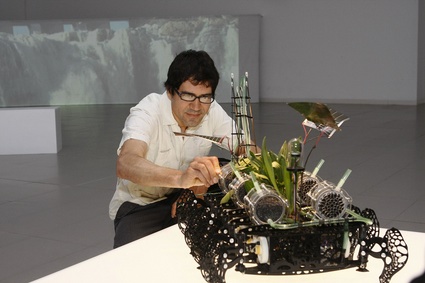
Gilberto Esparza first appeared in the radar of bloggers a couple of years ago when he started colonizing Mexico City with Urban Parasites. Made of recycled consumer goods, the small robotic creatures explore the urban space in search of any source of energy they can feed on. Under its quirky, amusing side, the project also had the objective of providing a basis for a critical exploration of the role that technology plays in cities.


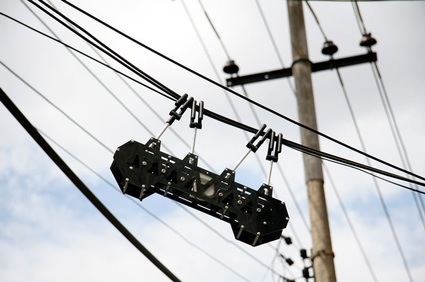
The dblt feeds on the energy that runs through electric wires. The species collects sounds in the environment and reproduces them sporadically. Photo Gilberto Esparza

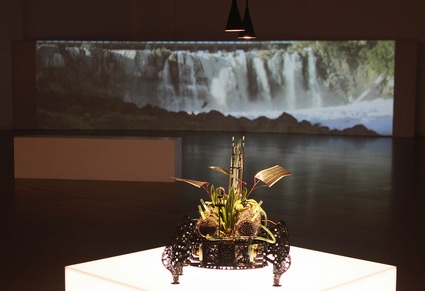
Gilberto Esparza is currently showing one of his latest projects, Nomadic Plants, at Laboral Art and Industrial Creation Centre in Gijón. Just like Urban Parasites, this new work is part of a series of experiments that aim to stimulate a critical discussion about the ambiguous forces wielded by technology.

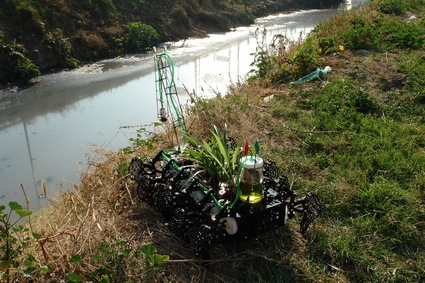
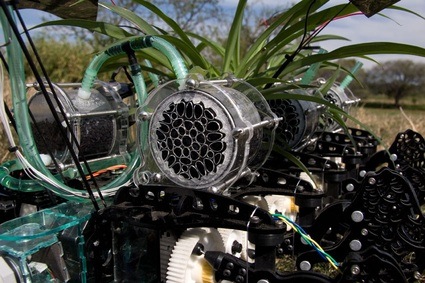
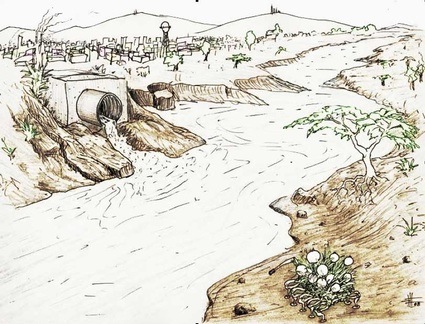
Vegetation and microorganisms live in symbiosis inside the body of the Nomadic Plants robot. Whenever its bacteria require nourishment, the self-sufficient robot will move towards a contaminated river and 'drink' water from it. Through a process of microbial fuel cell, the elements contained in the water are decomposed and turned into energy that can feed the brain circuits of the robot. The surplus is then used to create life, enabling plants to complete their own life cycle. As Eduardo wrote in our email conversation, "The nomadic plant is a portray of our own species. It also deals with the alienated transformation of this new hybrid species that fights for its survival in a deteriorated environment."


Photo Gilberto Esparza


Image courtesy Laboral Art and Industrial Creation Centre

I'll quote the artist again, this time from a text included in the press material for the exhibition:


The fact that a new species, the by-product of those alienating processes, appears -merely by coexisting- in those areas of ecological disaster represents a manifestation pointing to the serious social and environmental impacts on communities that once depended on rivers, now the source of their ailments. At this point, it is important to highlight the ambiguous potential of the transforming power of the human species, due to its ability to destroy but also to restore. For that reason, what is required is a new way of thinking, which would position us as antibodies on the planet, and a proper understanding of the importance of living in symbiosis with our planet and with all species.
When i first read about Plantas Nomadas, i immediately thought about Archigram's Walking City because of the nomadic and self-sufficient qualities of Plantas Nomadas. But what was your actual inspiration? Sci-fi novels and movies? Ongoing research in laboratories exploring the possibilities of microbial fuel cells in robotics?

I have been researching and building autonomous robots that can survive in urban space, stealing the energy that the city itself generates. Later on, i found online some publications about research projects using microbial fuel cell. I was immediately inspired to develop a project that would engage with the issue of pollution in rivers. I visited El Salto Jalísco, a community very affected by this problem. I was therefore interested in making it the location of the intervention.


Drawing by Gilberto Esparza

Can you tell us which kind of plants and micro-organisms cohabit inside the body of your machine?

The microorganisms that live inside the robots are identical to the ones you can find in the river. I prefer to use the plants that used to be native to the river before it became so polluted.

How has the public reacted to your work so far? Both in Mexico and in Spain?

People liked it a lot because the project opens many doors on issues such as our relationship with nature, the thin line that separates the inert and the living and also the directions taken by scientific research which, very often, respond to the interests of the current economic system.

Thanks Gilberto!


Image courtesy Laboral Art and Industrial Creation Centre

The installation at Laboral features the robot but also a video of the process of its creation, a documentary showing the robot in action in the river Santiago, El Salto, Jalisco (Mexico), a series of photos taken by the artist and computers showing the project's webpage.

Plantas Nomadas is on view at Laboral, Gijón (Spain) until June, 7, 2010.

Friday, April 16, 2010

Artist of the Week

Instead of highlighting random artists at random times, I've decided to feature an artist each week.  This creates (or creates the illusion of) more order in my life.

This week's artist is Sally Mann.


Her work is hard to pinpoint.  The above video is a nice introduction to her work and a scouring of the web will reveal a wealth of information.  Her photography is ethereal, mysterious, and, at times, confrontational. 

Best known for her series of photographic portraits of her children, particularly the series Immediate Family, Mann's work simultaneously disturbs and enchants.  The imagery offers a  raw and tender look into her personal life via her family and yet speak volumes about the undercurrents of social life within America that are frequently and deliberately overlooked.

On PBS' Art 21 site you can find a bio, some images, and some links.  If you are into contemporary art and don't watch Art 21 you are wrong.  I'm sorry to be so harsh, but it's the truth. http://www.pbs.org/art21/artists/mann/index.html

Thursday, April 15, 2010

Artist of the Week: Tiziano Vecelli or Tiziano Vecellio aka Titian

Titian is one of those artists that I forget about and then through happenstance come across one of his works and think to myself, "Oh yeah. I like that guy!"  He is one of the few Italian Renaissance artists whose use of color isn't so garrishly typical of the period that one can look at his work and not necessarily say to themselves, "Yeah, that's an Italian Renaissance painter."  And I like that about his work.

Many of his pieces have a naturalistic feel that presents a refreshing contrast to the more refined classical pieces of the period.  Although much of his work contains subject matter congruent with what one would expect to find during the Renaissance, his paintings contain a warmth and a soul that I think is absent in many of the other commissioned pieces of his day.

Below are some of his works:


Self Portrait


Giorgione and Titian. Portrait of a Venetian Gentleman. c.1510


Portrait of a Man. 1514


St. Mark Enthroned with Saints. c.1510


Portrait of a Man. c.1512


Assumption of the Virgin (Assunta). 1516-1518


Portrait of Pope Paul III without a Cap. 1543


Allegory of Time Governed by Prudence. c.1565


St. Sebastian. 1575

Sunday, March 28, 2010

Artist of the Week : I'm in the Mood for Caspar David Friedrich

As spring approaches here in Missouri, my better half and I get the urge to frequently travel around the backwoods roads in search of wildlife, new scenery, old buildings, aliens, and new valleys to explore.  South of here, the landscape is rugged and marked with crags, bald hills, and other typical Ozarky type minutiae that always reminds me (to some degree) of Friedrich's work.

Friedrich was a German painter active back in the early 19th century and although his paintings certainly can be evaluated and analyzed via a critical eye with regard to pantheism, the divine element within nature, man's place and struggle with nature, blah, blah, blah, I am going to post them simply with regard to a purely subliminal consideration of their intrinsic beauty.  This post shall be a tribute to the visceral response--"It's pretty!"--which normally sets me on edge for reasons that nobody cares to hear (trust me, I've tried to tell plenty of people). 

"Genießen," in the words of the Germans, although I'm not sure which ones exactly,


The Wanderer Above the Mists


The Abbey in the Oakwood


Evening


The Lone Tree


Largeness


Landscape with Oak Trees and a Hunter


Two Men Contemplating the Moon


Monk on the Seashore

All of these images were obtained from http://www.caspardavidfriedrich.org/ on March 28, 2010.  There are plenty more at this great site if you are interested to see more of Friedrich's work.


Friday, March 26, 2010

Artist of the Week: Andy Goldsworthy: Easily One of the Coolest Artists on the Planet

I came across an Andy Goldsworthy book while perusing a bookstore that I desperately wanted but (naturally) could not afford so I'm going to post some of his images here via the power of copy and paste.


Movement, change, light growth and decay are the lifeblood of nature, the energies that I try to tap through my work. I need the shock of touch, the resistance of place, materials and weather, the earth as my source. I want to get under the surface. When I work with a leaf, rock, stick, it is not just that material itself, it is an opening into the processes of life within and around it. When I leave it, these processes continue.  Goldsworthy

Search This Blog